
Patients Diagnosed with Eczema Are at a Higher Risk of Developing Asthma and Certain Allergies
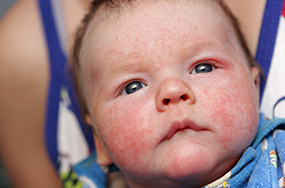 Three in a hundred people will experience atopic dermatitis, a prevalent form of eczema, at some time in their lives.
Three-quarters of patients who have eczema have also endured other allergic disorders. In fact, approximately 30% of those with atopic dermatitis (AD) also have asthma... and up to 60% experience allergic rhinitis.
AD often occurs during infancy and the early childhood years. Eczema in infants is frequently due to food allergies such as milk, wheat, eggs, chocolate, or acidic foods. We usually start our patients on a food elimination diet for one or two weeks. We then challenge with one food at a time in order to determine which food, if any, is causing an allergic reaction. Eczema can also be caused by environmental allergens, such as house dust, animal dander and molds, in which case immunotherapy (allergy shots) can provide relief.
In infants, AD symptoms include red, itchy patches that appear on the face, torso, and outside of the arms and legs. Older children may experience these patches in the creases of the elbows and knees, and on the wrists, ankles and feet. Skin may also become drier, thicker, and have deeper creases. Patches may scale, crust, or ooze; patients are very susceptible to bacterial and viral skin infections while experiencing these symptoms.
The primary goal in treating AD is to prevent itching. When an AD sufferer scratches irritated skin, outbreaks will flare, providing an open door to infection. These infections are not to be taken lightly... both herpes simplex virus and smallpox vaccination virus can spread rapidly on the eczematous skin. Progressive cases can cause serious systemic disease that is occasionally life-threatening.
Itching can be halted by keeping the skin moist. Special emollients should be applied three or four times a day. Bath water that is too hot may produce itching, so lukewarm water is recommended.
Fabrics, too, can be a skin irritant. Some individuals are very sensitive to wool, polyester, and some blends. Soft cotton causes very little itching. We suggest the use of detergents that are manufactured without fragrance or harsh chemicals. Some are marketed specifically for individuals with sensitive skin.
Topical dressings such as hydrocortisone cream can provide relief, and oral antihistamine medications may also be prescribed for the same purpose. In some cases oral steroids may be indicated, but only if symptoms are severe. If a specific antigen is identified, often immunotherapy (allergy shots) can provide relief.